
.jpg)
PROTECT YOUR DNA WITH QUANTUM TECHNOLOGY
Orgo-Life the new way to the future Advertising by Adpathway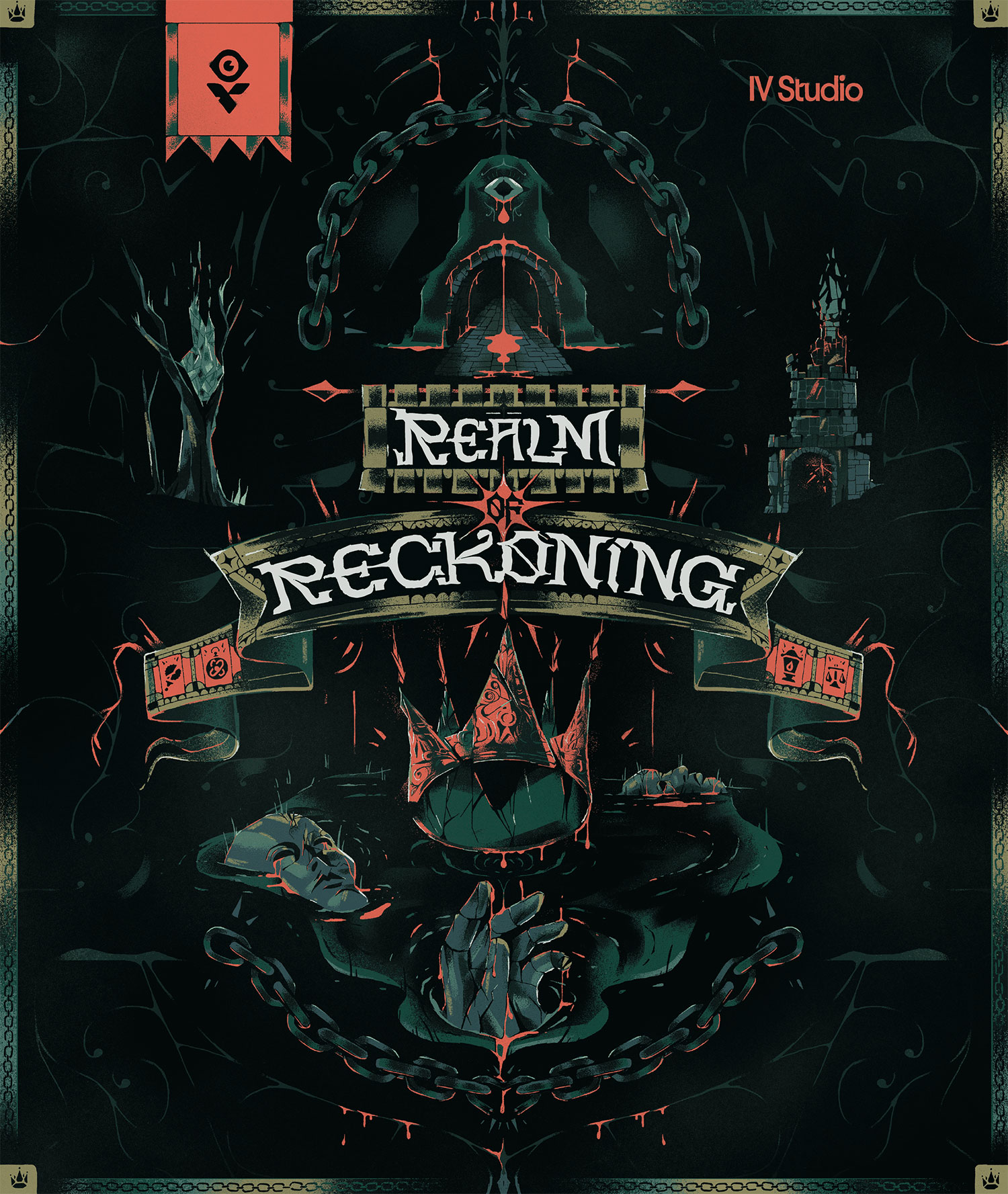 IV Studio’s first game Moonrakers, was the first game I ever crowdfunded. I was struck by their combination of old-school design ideology, paired with marketable and upgraded components and art. Unfortunately, I found Moonrakers too simple to be fine. Because of that opinion, I never really checked in with their output of the last dozen or so releases.
However, Realm of Reckoning caught my eye for its variable victory conditions, so I decided to give it a shot. Let’s see how that worked out.
Gameplay Overview:
In Realm of Reckoning, two to five players compete as warring factions to regain dominance in the realm after the collapse of the Queen of All Souls. In basic terms, collect the most victory points. Surrounding the area-control map of the game are 17 spots where monuments can be placed. Once a monument is placed, whatever that victory point condition is, is now eligible to be scored. Five are related to influence of the five different regions; five are related to drafting cards corresponding with the five different regions; and the remaining seven are a hodgepodge of miscellaneous and/or leftover resources.
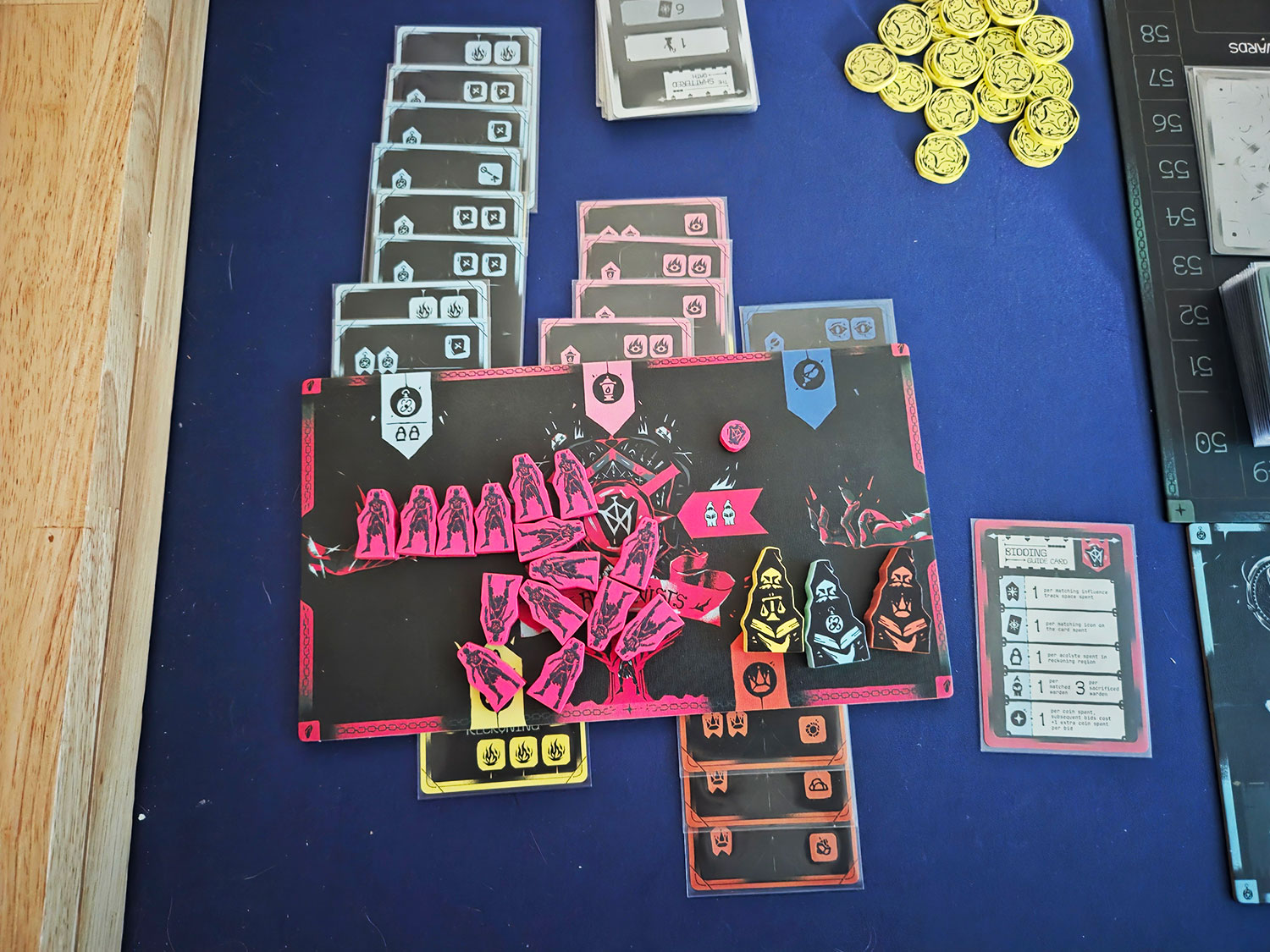 I MAY have scored quite a few points in this game…
A player’s turn in Realm of Reckoning is quite simple: draft a card, play the card, pass the hand. The cards come in two categories: Action Cards and Reckonings. Action Cards have a simple action in the middle of them (essentially gaining an amount of the four main resources in the game) and have symbols and/or influence for different regions on the top and bottom of the card. Once the middle resources are gained, the card is then tucked in the appropriate spot in your player board, and you gain the symbols and/or influence for that region. Reckoning cards work quite differently.
Reckoning cards are specific to a region: The Fragmented Forest Reckoning applies only to the Fragmented Forest. The player who drafted the card then gets to decide which other region’s influence can be used in the Reckoning, as well as the rewards for winning (or losing) the Reckoning. Then a simultaneous, hidden bid happens to see who wins the Reckoning. Five different resources can be used in the bidding, with some resources having more impact on the bidding than others, and some resources generating free bids for the auction. Once everyone has settled on their bid, the winner gets to choose the reward they desire. Each reward card has a monument (again, the piece that determines which victory condition will be active), heavy resource options, and a penalty space where some resource will be docked.
The game takes place over three rounds, and in each round three Reckonings will take place. At the end of each round, the victory conditions with monuments will be scored. This means that monuments placed in round one will score three times, monuments placed in round two will be scored twice, and so on. Draft wisely, bid with appropriate aggression, and play to the victory conditions to conquer the Realm of Reckoning.
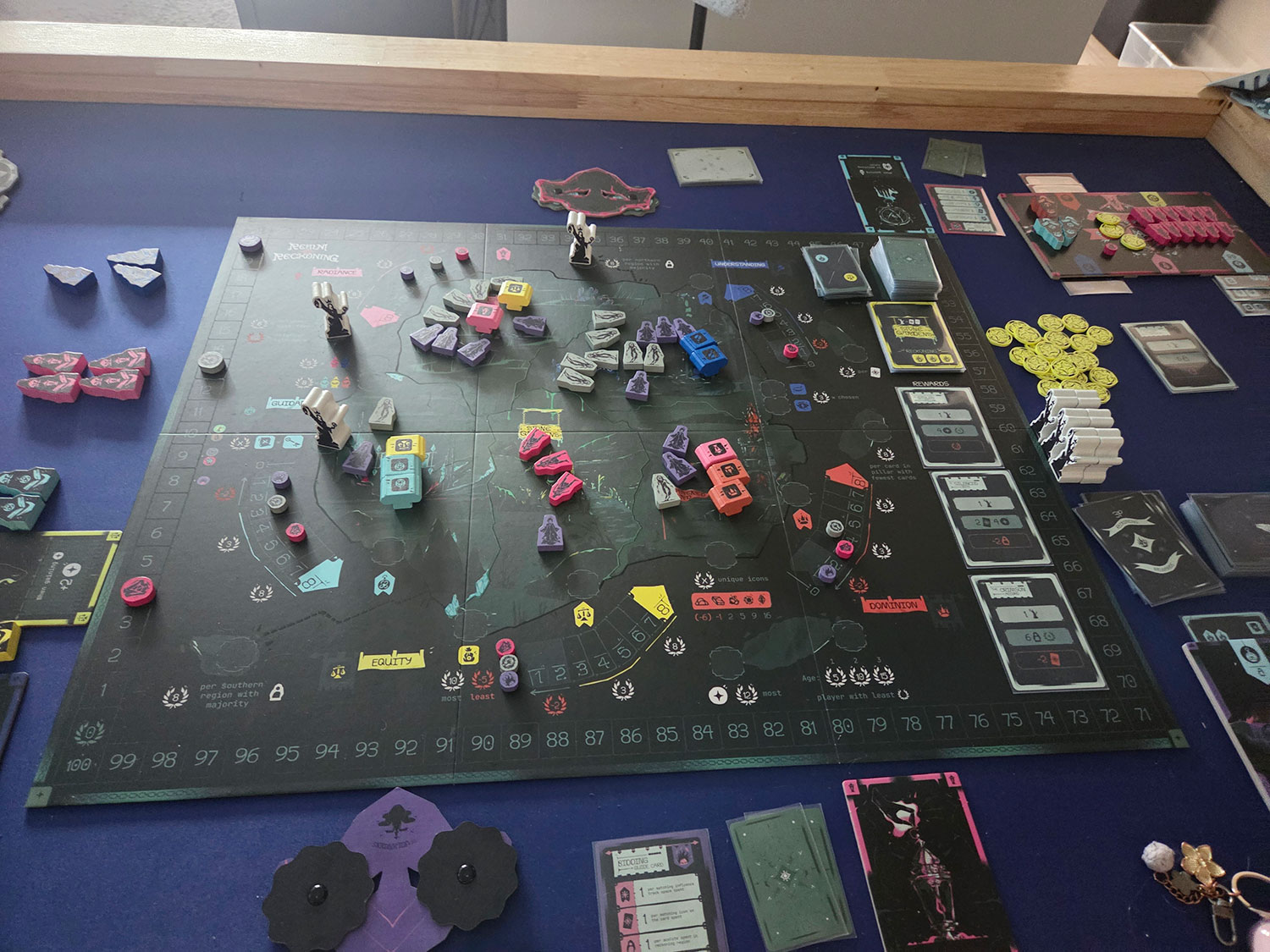 I PROMISE it’s not as hard to read once you’re in the game.
Game Experience:
While the rules do have nuance to them, Realm of Reckoning can be boiled down to a simple concept: collect a bunch of stuff, spend some stuff in auctions to be competitive in them, and don’t spend too much of the resources that will be scoring points at the end of each round. This central, simple thesis is easy to remember and understand, but the push and pull of the game causes everyone to lose sight and get greedy.
There are often sacrifices of resources that guarantee points for the possibility of getting more points by getting to choose where the next monument goes. Every single auction is engaging and often quite bitter, even at three players, because nearly all resources that can be bid on are open information. It’s simple math, but because the bidding is simultaneous and hidden, the auction is less about absolute value and more about understanding the people you’re at the table with. It’s absolutely brilliant.
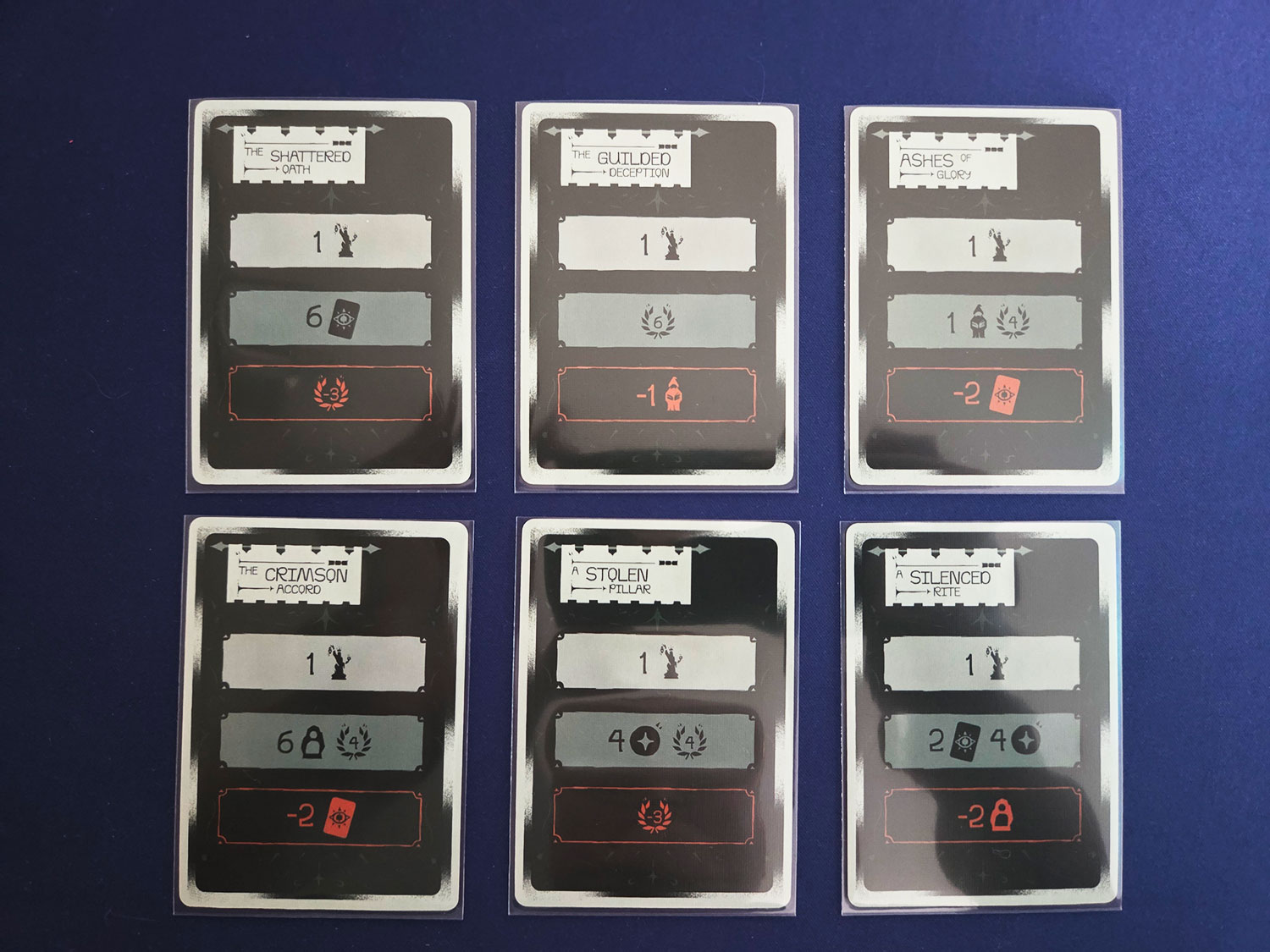 The varying rewards make every auction worth considering.
My main gripe with the game is the uneven victory point conditions. Some spaces award five points, and some spaces scale multiplicatively, so much so that in one game, I was able to score 40 points off of that one space alone. It might seem like this could be counterbalanced: in order for me to get 40 points in that one space, I had to lose out on points in other spaces, keeping the competition tight, right? Unfortunately, Realm of Reckoning is a resource-dense game, so getting some points from nearly every monument happens more often than you might think at first glance. Sure, my opponents might score 10+ from a space, but I’ll still get five or so, leading to a much smaller gap in points.
What’s even more upsetting is that if there’s a “house rule” to remove the infinitely scaling spots (of which there are only a few), then the game becomes one that has no punch to it. A player gains eight points at one monument and then two at another, but another player gains two points at one monument but eight at another. It is those multiplicative, high-scaling spaces that push the game into excitement, and it is those same spaces that push the game out of balance. It’s an incredibly tricky position for the designers to be in, and unfortunately, I think the designers miss here.
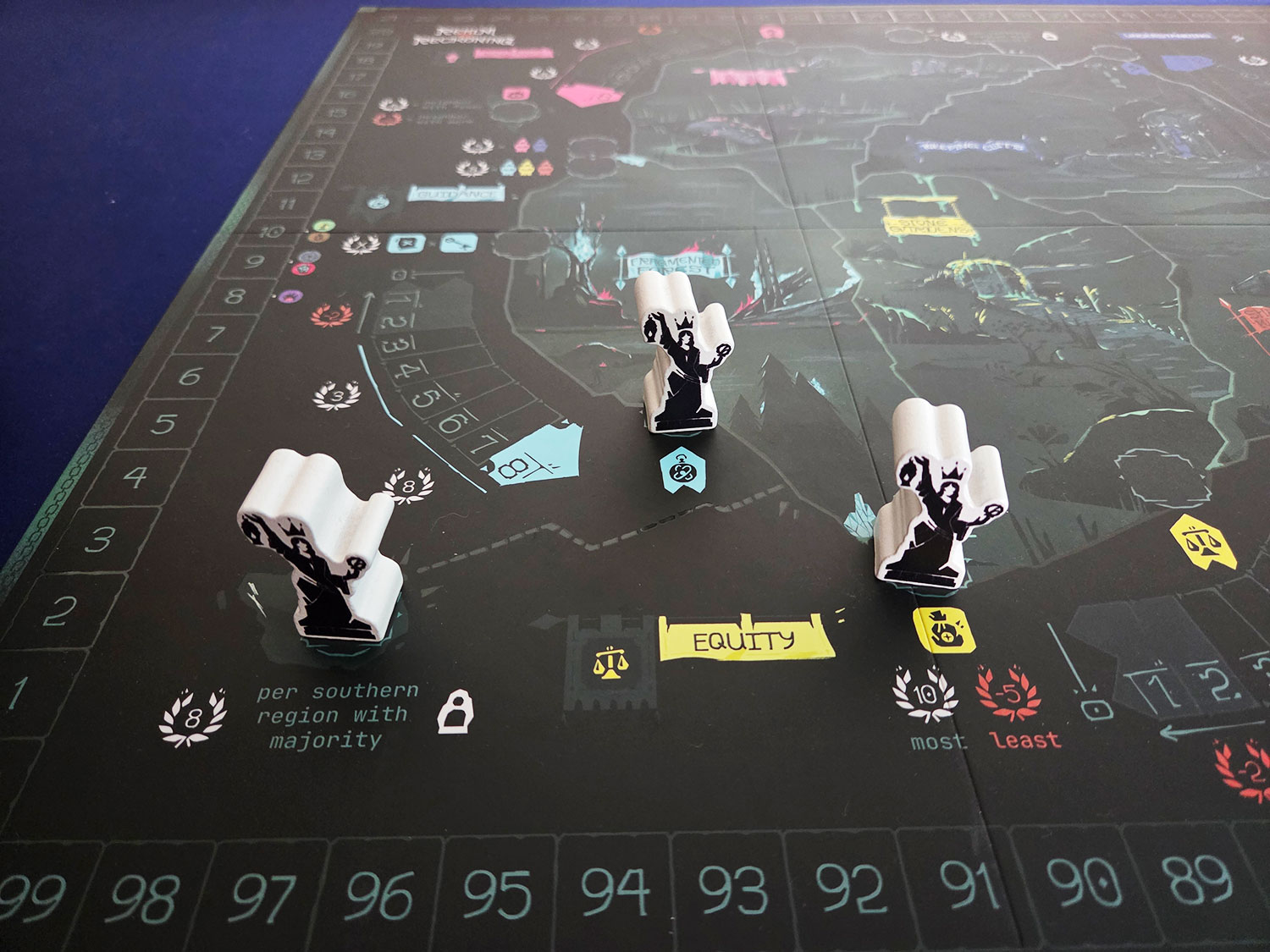 Marking which victory conditions are active with these gorgeous components really adds to it all.
And yet just as the victory condition inclusions feel contradictory, my feelings on the game are contradictory as well. I can nitpick certain aspects of the game until I’m blue in the face, and yet playing the game is so engaging moment-to-moment that I don’t particularly care what the final outcome of the game is. It reminds me of Oath in this way: the narratives created and swings for victory matter as much as the victory itself. It’s an absolute joy to play from start to finish, and in my opinion, it has much better emergent storytelling that Cole Wehrle’s entire catalogue, beating out Oath, Arcs, and John Company by a mile.
Final Thoughts:
Realm of Reckoning is a simple game in its design, but a complicated one to enjoy. It has the fragility of cube rails and 18xx, and the storytelling-through-mechanics of most of Cole Wehrle’s output. I can understand why this game would be someone’s favorite, and I can understand why this would be someone’s least favorite game ever. It feels more like a Hollandspiele title than an IV Studios one, and that is high praise from someone who really enjoys player-driven, fragile games. Is this game flawed? Absolutely. Can players be blocked from going nuclear? I’m not sure, but I’m leaning towards “not as much as is needed”. But is this a game I would like to play over and over again? Absolutely.
Final Score: 3.5 Stars: A divisive game. Play it at all costs to see if it’s for you.
 Hits:
Hits:
• Gorgeous production
• Simple design & gameplay thesis
• So much player controlled chaos
Misses:
• So much player controlled chaos
• Tricky scoring spaces to counterbalance
• Prone to heavy analysis paralysis

/pic9795538.jpg)

/pic9878503.jpg)






 English (US) ·