
.jpg)
 1 day ago
16
PROTECT YOUR DNA WITH QUANTUM TECHNOLOGY
Orgo-Life the new way to the future Advertising by Adpathway
The Origin
I forget the exact chain of events that lead up to Christian sharing an early prototype of Final Titan with me. We were talking about autobattlers, a digital game form that I think is particularly good for board game players. My early attempts to make autobattler board games felt clumsy; like they would be more fun on computer than around a table. We were also talking about making an analog to Magical Athlete – a simple battling game with warriors that have special powers rather than a simple racing game where the racers have special powers. I am not sure if I realized, at that point, that Magical Athlete was effectively an autobattler.
Christian: An amusing fact is that at that point, I had actually never played Magical Athlete, though I had a vague idea of how it worked. This was one of those designs where the initial prototype was already working extremely well and though many mechanisms changed, the feelings and excitement of the players remained from those initial plays.
Marvin from Nerdlab participated in those very early playtests and immediately offered to sign the game. Despite it being in a rough and very early prototype state, he immediately saw huge potential in it. Nerdlab had knocked it out of the park with Mindbug. But they were also a small company. We considered if a company of that size could really pull it off. I remember Richard had a strong vision for the game, and he really wanted it done right. He agreed to go with Nerdlab on one condition: There should be 100 Titans in the game. This is an absolutely crazy and wildly ambitious number. I think most companies would do 20-30. But Marvin agreed and we are all extremely proud to have delivered on that promise.
The gameplay, described briefly: Each player drafts a team of Titans. These take turns fighting 1-on-1 in the middle of the table. When one Titan wins, it stays in the middle and the other players spend resources in a No Thanks way, to avoid having to go in and fight it. The fights themselves are resolved through rolling a single die, which in turn triggers all kinds of attacks, rerolls and crazy abilities. It sounds dumb, and it kind of is. Yet also strangely exciting once you try it.
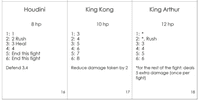
The Interaction
The thing that most excited me about Christian’s design was the interaction, which he described as a No Thanks! style auction. I am always interested in the interaction in games – I enjoy many low interaction games but feel that higher interaction games are often underrepresented. Being able to interact more with another player can bring a host of problems – and I have a big virtual toolbox for ways to deal with that, and this felt like something new.
To illustrate what I mean, consider my game King of Tokyo, which was originally an exercise to make Yahtzee more interactive. In King of Tokyo, I use a king of the hill style interaction; players can generally only affect a player who is on the hill (in Tokyo), and a player who is being attacked can always retreat from the hill. This makes it so you can have a highly interactive game but aren’t constantly needing to choose who to pick on, and can limit how much people can pick on you.
With Christian’s No Thanks! interaction, you have a champion and players bid for the right not to challenge them. Eventually someone will have to challenge the champion, but players aren’t choosing which other player to pick on, and, they have some agency in what battles they are involved with; it serves a similar purpose to the interaction in King of Tokyo but feels fresh. It also reminded me of Poker; even though Poker is usually played with many people, the interaction often ends up being two players with other players saying “No Thanks!”
This idea is powerful – in a game where you want to be the last standing the best position to be in is always watching other players fight. Bidding for that position rather than, say, the right to fight makes a lot of sense.
Christian: Players of Final Titan will probably never think of it as an auction game, but indeed one of the central mechanisms is a no-thanks style auction, where players are spending upgrade-cards to avoid going in and fighting the blood thirsty Champion that is waiting in the middle and probably totally overpowered.
Evolving the Interaction
Originally the bidding was done with chips, each player had some chips and could spend them to avoid a fight. Early on, however, we felt we could use cards instead of chips and give the cards some play value. This would give players some more decision making with the card play, and with figuring out which cards to spend to avoid a fight. As anyone who has played No Thanks! would expect, the chips were already much more interesting than they seemed at first since the value of the chips changes based on what the current distribution of chips are. Making it so that the chips were different from each other gave us another layer of interest.
This wasn’t an easy transition, however. We were all on board for adding these cards, but what cards to add and how powerful they should be? I would guess, in fact, that this was the biggest design challenge in the entire project. I believe the main issue always came back to power level. We wanted the cards to be spent to avoid fights, not just played to win fights.
If the cards become powerful enough to reliably swing a battle then the dynamic is more about collecting and spending cards than it is about ducking dangerous fights, particularly since we wanted to give a bonus card to the victor each time. At its extreme, no one will spend cards to avoid fights – the next person in line will challenge rather than give up a card and the dynamic becomes one focused on the cards rather than the hero match-up. A good game can be made this way – and in fact I think we went through several – but it is much more pedestrian… you step up on your turn and decide how many cards it is worth investing, rather than spend cards to duck the fight and possibly get a big haul of cards when you choose to fight.
I remember many iterations where alarms were going off in my head as players became too attached to their cards and would always step up to avoid spending them. This sort of thing is sometimes difficult to spot as a designer, because we know how the game is ‘supposed’ to be played and we tend to play it that way. If we aren’t actually in the game though, and people choose – correctly or not – to play in this way the entire game can suffer.
Final Titan worked fine, in fact, I think it worked great with the cards just being blank. That emphasized everything we wanted the game to be about, finding the right matchups and only being able to avoid the wrong ones so many times. However, we couldn’t simply make the cards weak – there were some versions we played where the cards were so weak and uninteresting that I stopped paying any attention to them. At this point we would be better off going back to chips, which felt like a lost opportunity. The cards had to be strong enough to consider and compare, but not so strong that you wouldn’t look at a fight and say… “nah, I think this should be someone else’s problem.” To me, it was that particular decision that made this game special.
One approach that worked pretty well was making cards that were situationally good, or good for particular characters or matchups. These could be relevant and potentially game changing, and yet clearly worth pitching to avoid the wrong fight.
The other problem facing the cards was keeping them from slowing down the game. If you have cards that you can play during the fight, then you risk slowing the game down a lot. Cards like ‘reroll an attack’, or ‘dodge an attack’ will inevitably lead to the game slowing down as players stop to make sure there is no card play, or barrel ahead and hear “wait – go back, I didn’t get a chance to play this card!” There were some natural windows to keep the cards in which wouldn’t slow the game down much – like – cards that are played before you roll, or before the fight starts, or after the fight ends.
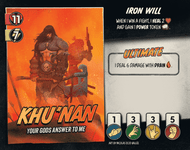
Christian: Ah yes, figuring out the right way to do cards was definitely the trickiest part of development. I was particularly sensitive to the occasional occurrence of “Oh don’t roll your die yet, I was considering playing a card”, despite it generally having very good gameplay. In the end, we went for all card plays happening before the start of each fight, to make the fight flow as smooth as possible.
Evolving the Fights
The way the fights worked also evolved over time. At first we threw everything into the game to get a sense of what worked well and what didn’t. This is often a technique I use, rather than carefully prescribe a domain which I know will work, I try it all then cut back as needed.
One of the most important features added was a critical hit, which eventually lead to a fun, distinct ultimate power for each fighter. This came about in part because situations could often feel hopeless, and it gave the player a way to win.
The other side of the coin was the fail, the miss, the blank side of the die. The presence of that along with the ultimate power meant that every roll, in general, could succeed or fail; which kept the matches alive and with the possibility of surprise far longer than when these were not a baked in part of every character. There will still be hopeless situations, like with poison, but their rarity makes them special.
There were some times where we experimented with giving the standing champion a disadvantage in order to make the turnover more reliable. I think there was one character in particular that made us consider that – maybe it was a well-known Barbarian – who had a bit of difficulty winning the first match but would heal and get stronger after each victory. I always came down on the side of wanting the champions, if anything, to have more defensive power because it is the entrenched victor that has an epic battle to oust that stands out as the most exciting sort of story that can come out of Final Titan. The standing champions usually have a disadvantage anyway since they often have diminished life points, and always have the disadvantage of their opponent being able to choose the best matchup from those available. I think the game just tends to become more exciting as a champion notches up a few victories; and if they can ride that all the way home? Well, it is a short game, play again!
Christian: For a while, all characters had the same “ultimate attack”, which was simply a KO. The guys at Nerdlab really wanted each character to have its own Ultimate attack. I remember fighting this for months as I did not for a second believe that there would be enough design space to make this a reality. In the end, mostly to finally shut them up, we gave it a shot giving each character their own ultimate attack. It immediately worked super well and I kick myself for having fought against it for so long.
The Flavor
Final Titan was a battling game, a game in which players drafted and then fought some sort of character in a series of 1v1 battles that would leave a single champion. But, what were those characters? Where was that battle? The first draft was a collection of characters taken from public domain books, including, for example, King Arthur, Alice (of Alice in Wonderland), Frankenstein’s Monster, Sherlock, the Artful Dodger, and even Moby Dick. It was meant to be a placeholder flavor, but its charm helped guide it to its final place.
As champions were added to the mix, many were not public domain – which we intended not to use but to inspire us for mechanics and tone – like Conan and Shelob. As we understood and explored the mechanics more we began to make champions from the mechanics – for which we often used a faux-superhero flavor.
To this point we hadn’t really decided what the flavor was going to be, and there were many places it could have gone. I remember one approach in particular was kids battling toys in a toy grand melee; so all the champions would have been Dolls, Toy Cars, and Stuffed Animals, for example. The merit of such an approach is that it looks fresh, unlike, say, generic fantasy. The problem with such an approach is that a potential player doesn’t really understand what is going on immediately, and when they are picking the champions they often can’t read much into the images. You have some idea of what a dragon or an ogre might represent in a battle, but, a rocking horse and a football?
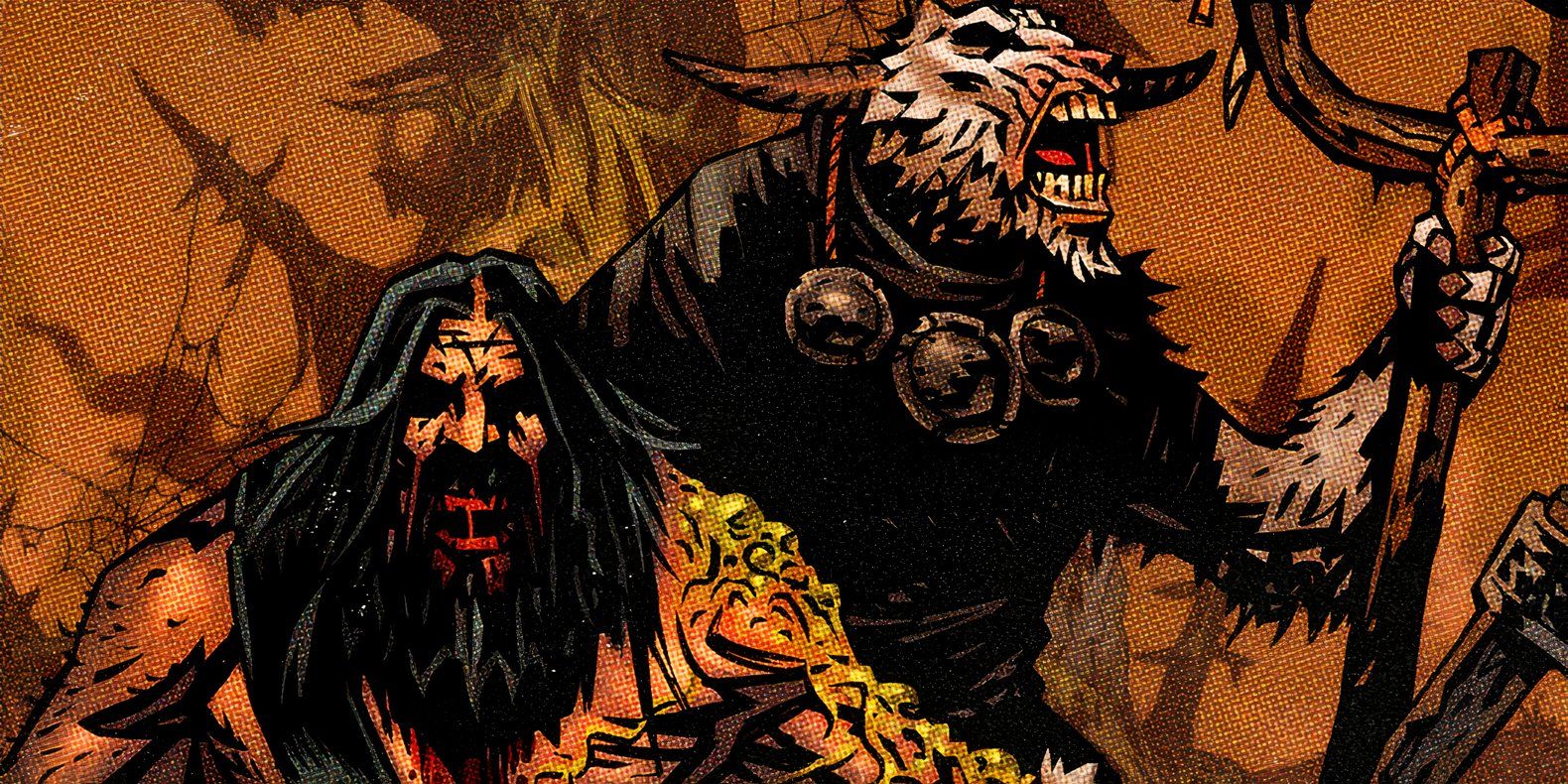
In the end we chose to go with Superheroes. It was easy and fun to translate what we had into superheroes, and the origin of the characters from its public domain roots often gave them an original, but plausible presence. Tying them together with art from their comic books really gave the game a cohesive feeling – one in which any onlooker could tell what was going on. Also, it felt endlessly expandable – so we could make as many as we wanted, and any fans of the game could easily add their own if inspired to do so.
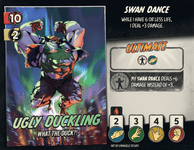
Christian: As a little anecdote, I wanted to have a character representing my home town of Odense, which is probably most famous for being the birthplace of author Hans Christian Andersen. We chose one of his characters, The Ugly Duckling, though of course it was represented in an over the top crazy muscular version which felt fitting to the game.
The Name
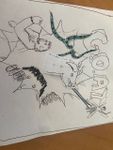
During most of the game development we called the game G.O.A.T. We all liked the name; I even mocked up a box cover complete with a goat bursting through the background. However, it turned out that there are legal claims to the name and we would be better off choosing a different one.
As usual, this process was difficult. When my games have had to be renamed, they often end up being unable to stand up to the original name, at least in the minds of the people who had lived with that name for so long. Sometimes you end up with a worse name, like I think happened when "Fat Dracula" got changed to The Hunger. Occasionally a better name, like when "Inconceivable" got changed to Half-Truth. Sometimes we give up and go back to the original as happened with Magic, which changed to "Mana Clash" briefly before we went back with Magic: The Gathering.
With G.O.A.T. we couldn’t find anything that pleased us all in the same way. We worked on it quite a while and it felt like we weren’t ever going to find something with the feel we wanted – light humor with something of the nature of the game reflected in the title. It was undoubtedly not helped by the fact that we had people from at least four different countries weighing in who saw, for example, different connotations for the word Titan. For a long time my favorite name was one of Christian’s (I think), 100 Titans. I liked it because it felt humorous and would also force us to deliver at least 100 characters – which was the sort of epic number of champions I wanted to see. Also, leading with a number felt distinctive.
Not everyone cared for 100 Titans, though. One reason was quite legitimate, which is that it did commit us to 100, and also it might look weird if we added more. We ended up with Final Titan, and for me, this name works quite well. I liked that it told you something about the game, and felt a little cheesy but was still, to me at least, pretty cool. I hope that the rest of the team has grown to like it as much as I have.
Christian: And here we are, at the end. Development was long as this was one of the most ambitious projects I have been a part of. But we are very happy with where it ended: A box of 100 cool, different, weird, and wonderful Titans to keep players excited and engaged for a long time (actually more like 140 if you include expansions and promos). While development is a lot of hard work, we also got the pleasure of continuously seeing new and exciting artwork from the super talented team of artists that worked on the game. Seeing our ideas turn into these amazing comic-book-like characters was such a thrill, it is just the best feeling.
Final Titan is now being released into the wild. I actually expected the game to be quite divisive, but so far it has been extremely well received from reviewers and players, who really seem to feel that same weird excitement of rolling a die and seeing what happens. I will end with a quote I really liked from a comment here on BGG:
“I was a doubter. I watched some videos. Heard the rule summary. Draft dudes, then roll until someone wins. How could that be fun? Where's the crunchy decisions? Really, where's any of the decisions? But then I saw the a demo on TTS, so why not? I tried it out... and then immediately late pledged.
I think you need to see it to believe it.”
I think you need to see it to believe it.”





 English (US) ·