
.jpg)
 13 hours ago
2
PROTECT YOUR DNA WITH QUANTUM TECHNOLOGY
Orgo-Life the new way to the future Advertising by Adpathway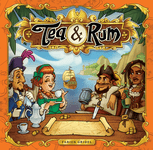
When you sit down to design an expert game, you have much more freedom than when you design anything else. Players will forgive convoluted mechanisms, longer rules, and above all a playing time longer than an hour.
That said, just like my last expert title (Path of Civilization), it still has to be easy to get into. It has to play smoothly, and it has to end at the right moment. I'm firmly in the European school of design, where chaos, luck and noise take a back seat to planning, management and strategy.
Where Do You Even Start?
I'm lazy. I'll think for hours before I actually do anything. I take almost no notes. And my thinking always circles around one idea I want to dig into: something new, or something I think board games haven't made enough of yet.
No, Tea & Rum isn't going to reinvent modern board gaming. But I did want to bring something new to the table. Little mechanical hooks, as I think of them: the kind that flip how players look at a game, and that get people interested the moment you describe them out loud. That was the brief from day one, do something new.
I. Standing on Other Designers' Shoulders
Designers are gamers first. Of course we feed off everything we've played. Tea & Rum is unconsciously the descendant of a hundred different games. But here are the ones that actually made me stop and think, and what I took from each.
Die Säulen der Erde (The Pillars of the Earth), and how you get your resources

Die Säulen der Erde – Sonderausgabe – game box front (cropped) – Source: BGG
Every resource management game has two halves:
● getting the resources
● spending them
In a lot of games, getting them is the whole point, that's the engine. Tea & Rum turn it over. In Tea & Rum, what matters is what you turn them into: Captains, Contracts, Buildings.
So how do you make acquisition interesting without letting it take over the game?
Enter The Pillars of the Earth (Kosmos, 2006), by Stefan Stadler and Michael Rieneck. Their answer: a fixed resource draft. Which turned out to be exactly what I needed.
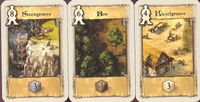
Resource cards for The Pillars of the Earth - Source: BGG
● The rate is great. The cash-per-cube ratio is good enough that you always want to buy something.
● It's strategic, because you have to already know how you're going to convert those goods later.
● A draft is interactive by construction.
● Sometimes you're better off sitting on your money to grab a Captain at the top of the Round. You shouldn't be buying at any price, and that tension gives you plenty to chew on.
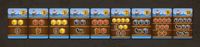
● Unlike Pillars of the Earth, every Ship card in Tea & Rum offers you several different options.
Tzolk'in, and the Joy of Picking Workers Back Up
You can't talk about Tea & Rum without talking about Tzolk'in. Why? Because it's worker placement where you get to do the action when you take the worker off the board. The longer you leave it out there, the stronger the payoff.

English second edition (2014) cover – Source: BGG
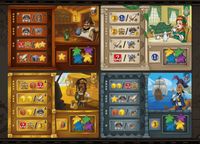
Tea & Rum uses that same idea, but uses it completely differently. On even Rounds you place workers. On odd Rounds you unplace them. Either way, placing or unplacing, you take an action.
Each of the four Action Boards in Tea & Rum has its own personality, its own perks, its own actions. Everyone starts with workers spread across the four of them, but nothing keeps you honest after that. Drop two workers in the port on Round 2 and take two actions there, and you've just committed yourself to two more port actions next Round when you pick them back up.
That's a big deal, because it hands the player real control: you can guarantee yourself actions where you want them. And in an interactive management game, where what's available to you depends partly on what your opponents just did, locking down that certainty is worth a lot. It also means planning ahead, because you'd better make sure those actions are still worth being taken when you play the next Round.
Antiquity (2004)

Antiquity, Splotter Spellen, 2017 — front cover (image provided by the publisher) – Source: BGG
In the early 2000s I was fascinated by Jeroen Doumen and Joris Wiersinga's games. In 2004 the pair put out a monster: Antiquity. Long, brutal, with upkeep that borders on unbearable AND it stuck with me, because nothing else looked or made you play like it. That modern feeling that every game is gorgeous and every game is the same rubs me the wrong way. Antiquity is ugly, and Antiquity is new.
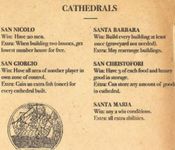
Of all the ideas crammed into that box, the one that stayed with me is that you pick your own victory condition by building your cathedral, a cathedral that also hands you a unique advantage. It's sneaky. It's fresh.
Choosing how you win. Now that's worth pulling on. But in a modern game, that choice can't be a trap. It has to be something a strategy leads you to, not something that punishes you for guessing wrong. So in Tea & Rum, the decision to play nice with the Crown and go for Governor got rebuilt around three ideas.
First, it's a draft: first player to 8 blue VP picks first its Allegiance Objective. That builds in a race, and the more you play, the more you'll notice that some allegiances are worth far more than others depending on how the game is shaping up. Second, you don't actually have to pull it off. Somebody is always crowned Pirate King, so failing your allegiance is nowhere near as fatal as blowing your cathedral in Antiquity. Third, the red VP attached to each allegiance are nothing to sneeze at anywhere from 1 to 5. Which opens the door to counter-drafting: taking an allegiance you are fully aware you'll never complete, purely for the red points and to keep it out of an opponent's hands.
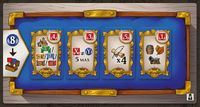
And finally, more on this later, it's one of the things that keeps the game from repeating itself.
II. The Co-op Wave, and the Second Winner
Since Pandemic in 2008, the co-op wave has been strong enough to swamp the hobby for a solid decade. There were great co-ops before it (Knizia's Lord of the Rings, Cathala and Laget's Shadows over Camelot), but I think that wave forced every designer to ask what kind of fun a game is actually selling.
A designer friend of mine put it well: sharing a loss takes the sting out of it, and sharing a win makes it sweeter. Win alone against everyone at the table and you have to be gracious about it. Win as a group, after a real fight, and you get to celebrate. So why does it have to be one winner or everyone? Nothing says it does. That's where the double victory in Tea & Rum comes from. Two winners means two players potentially walking away happy. And it costs you nothing in competitive tension along the way.
In other words: pure upside.
What it does for Tea & Rum is huge. For one thing, you have to watch what everyone else is doing. For another, the game can never end without a winner, because someone is always crowned Pirate King. And in the two-player game, knowing that nobody might win at all is honestly delicious.
III. Trying to Have It Both Ways
The victory point constraint was argued over for a long time.
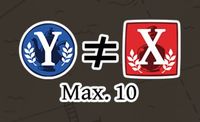
In the final version, you can't finish with more than a 10 VP gap between your blue points (the Crown) and your red points (the Pirates). Without a constraint, the game simply doesn't work. Players would tunnel on one color and completely ignore the other. Make it too tight, let’s say 5 VP, and the endgame becomes a nightmare. Ideally, a player chasing the win in Tea & Rum should be riding that gap right up to the limit. 35 red and 35 blue is a weaker position than 40 red and 30 blue. After a huge amount of testing, and weighing up how it actually felt at the table, 10 VP turned out to be the sweet spot.
IV. Nobody Gets a Playbook
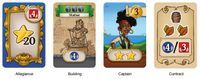
You know that sinking feeling in a heavy game when someone at the table already knows exactly what they're going to do sometimes before the lid even comes off the box? They know the game, they know which line is too good, and off they go. Everything in Tea & Rum is built to stop that. Sure, one game you'll think: wow, this allegiance is a free win. Then next game that same allegiance is a slog, because the building you needed isn't in play. And since you never play with all the buildings (except in a two-player game), I wouldn't be surprised if groups start pulling specific ones on purpose, rather than randomly, just to try all the different strategies. You can't skip reading the Captains and the Contracts either, because in some setups they're worth far more than in others, and you'll want to adjust accordingly.
Maybe that's the one word behind the whole design: adapt. Constantly.
That 'infinite replayability' everyone claims as proof that a game will last is, most of the time, not true.
V. Worker Placement, Or Action Draft?
Design-wise, worker placement is usually just an action draft wearing a hat. Here's what I mean: when you put a worker down, you pull an action out of the pool and nobody else can have it. Functionally, that's the same as holding every action card in your hand, taking one, and passing the rest along. Tea & Rum is worker placement, but it drifts a long way from a straight draft. Why? Because what your action does depends on how many workers are there.
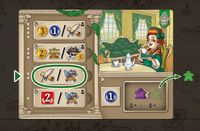
So instead of removing an action from the pool, you're changing one.
In most worker placement games, that kind of thing gets filed under indirect interaction. In Tea & Rum, you're not just taking an action somebody else wanted, you also have to think about which action you're handing them in its place.
VI. Interactive, Or Just Mean?
Anyone who plays expert games knows the deal: a lot of them are solo multiplayer, politely rebranded as "indirect interaction." The ship draft I mentioned earlier, the activation system that swaps one option out for another, the race for Allegiances, the sliding bonuses on the Contract board, all of it is there to put players in each other's way, and to make the game interactive without making it unpredictable or chaotic. No hidden information. No gotchas. You can see what your opponents are able to do. And YES ! This is fully intentional, and I'll happily own it. The game can be mean. Killing an opponent's shot at Governor by taking the last bit of Reputation they needed can be a genuinely great play. What's funny is how differently groups handle that. Some tables are vicious with it. Others just build their own engine and let an opponent run away with it, even when tripping them up would clearly have been the better move.
VII. Adding Insult To Injury
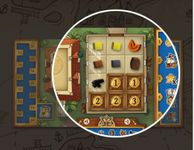
Kicking a player while they're down is a feeling I work hard to design out. You know the pattern: here's an objective hit it and you get a reward, miss it and you eat a penalty on top. Where does that come up in Tea & Rum? If you followed why the Ship phase and the start-of-round Resource choice matter so much, you'll see that having room in your warehouse is everything. Early versions had rigid storage. The result: any Round you failed to convert your goods as planned, you got hit twice, you missed out on whatever you were buying toward, and your warehouse was full, so you couldn't play the next Ship phase properly either.
We tried every formula to turn that into a management problem rather than a punishment. Sure, failing to cash in your resources on schedule should still hurt a little. But the fix we landed on is that you can pay to expand your Warehouse at any time. That kills the double penalty dead, because right after start-of-round income you can always afford enough space to take a normal part in the ship phase.
VIII. The Two-Player Game
Wait?! there's a two-player mode for a game designed around two winners? Yep. And you know what? It's terrific.
The game was originally built for three and four only, and honestly, three is still my favorite. But right at the tail end of development with Captain Games, a two-player version went from "nice to have" to "we need this." Lucky break: a colleague of mine loves expert games and plays almost exclusively at two. Hundreds of games of Agricola, for example all two-player.
Even better, he'd never seen the prototype when I showed him the two-player draft. We played a three-player game first so the rules were rock solid, then I walked them through the two-player changes. I left the prototype with them for two weeks, and they came back with an incredible stack of play logs and notes 20 plus games and more than 30 suggested changes.
The result: 90% of their suggestions made it in, and several of them fed back into the three and four player game and made the whole ruleset more consistent.
So no, there's no double win at two players. Victory takes shape round by round, pulled between the pirates and the Crown, with a new kind of tension that keeps forcing you to adapt and yes, it can end with nobody winning at all. That's rare, and it takes two genuinely nasty players to get there.
IX. On Publishing, Illustration and Finishing Touches
The game design of a board game can never skip a long development phase carried out with the publisher, covering ergonomics, but also the illustrator, who brings the game to life visually. The work done on both the artwork and the iconography contributes enormously not only to the readability of the game, but also to its fluidity.
Adrien, Captain Games' in-house illustrator, spent an endless amount of time reworking every icon and refining every drawing. This is not only a matter of publishing and art direction. It is also slightly tied to the creation of the board game and to the game design it serves. Many gameplay elements came out of this shared development with Captain Games. The development team in charge of the project was particularly proactive in putting forward ideas to solve several points of friction and balancing issues, among them: the removable Action Board tiles, which prevent any one position from being too advantageous, the streamlined management of the Warehouse...
Tea & Rum is an expert game, and it required close collaboration between all parties involved: the designer, the publisher and the illustrator, in order to produce the best possible version of the game.
Last Word
Designing Tea & Rum was long and hard, and like every game at this weight, it's full of dead ends, backtracking and hours of staring at the ceiling. But it's here: Captain Games has turned into a real product a vision of a heavy game that doesn't quite want to be like the others. It'd be easy to call it a patchwork of borrowed ideas. I'd like to think it's a little more inventive than its ancestors, and a lot more modern.
Go find it, play it, and share it.







 English (US) ·