
.jpg)
 1 day ago
11
PROTECT YOUR DNA WITH QUANTUM TECHNOLOGY
Orgo-Life the new way to the future Advertising by Adpathway
Spyrium was out-of-print after a while and no further print run was planned, and that could have been the end of the story.
Meanwhile, Sorry We Are French, besides entirely original designs, had been releasing new versions of previously published games – starting with IKI in 2021. When Emmanuel Beltrando contacted me in 2023 to enquire about the status of the rights to Spyrium, they were preparing Zhanguo: The First Empire, the new version of Zhanguo, which they would release at SPIEL Essen that year.
Emmanuel and I first met about two decades ago, around the time when Caylus was released (2005). After some time at Asmodee, he created his company Moonster Games in 2010, then Sorry We Are French in 2017 – and during all these years, we met once in a while at various fairs such as Festival International de Jeux or SPIEL Essen, chatted and occasionally played a game.
What is Spyrium?
Spyrium could be described as a worker placement game. During each of the six rounds of the game, a market is built with 3x3 cards, then players take turns placing workers between two adjacent cards (which does not prevent further workers from being placed there) – or a player may choose instead to remove one of their workers to activate one of the adjacent cards. Once a player has started removing workers, they may no longer place workers in this round, but each player decides individually when the transition from the placement to the activation phase takes place for them.
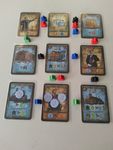
To activate a card is a choice between two options:
- pay to use one of the adjacent cards (depending on the card, it will go into the player's tableau or remain for further activations) – where other workers placed next to this card will increase the cost of this use
- renounce the use of the adjacent cards, but collect money – where other workers placed next to a card will increase the amount gained
Playing a game of Spyrium requires making lots of plans and discarding most of them, as other players make the card you covet too expensive, snap a card which you did not expect them to go for, or maybe allow you to collect more money than anticipated.
These few lines try to describe what defines Spyrium – what the cards actually do and how the players score points is not very relevant. With Ystari Games, we had chosen a Victorian England steampunk setting, where players would collect green crystals of spyrium in mines and build factories or laboratories to convert these crystals into victory points.
Making a New Spyrium
At SPIEL Essen that year (2023), I met with Emmanuel and Matthieu Verdier (who was in charge of development at SWAF and would be working with me on this new version). They both shared a love of Spyrium and a conviction that the game would have deserved a better fate, but none of us had a clear idea about how far the changes would go.
I had prepared a list of ideas, possible improvements and directions to explore – and when I met with Emmanuel and Matthieu, we realized quickly that we were in agreement on a lot of these points.
I was not interested in making a game 95% similar to Spyrium, with only minor adjustments. And since it was clear from the beginning that they wanted to get rid of the steampunk England setting – which was fine with me, as I had no strong attachment to it – we could change as much as we wanted until we would be satisfied with the result.
In that case… maybe my original thought about setting this new version in the Ganymede universe (which they had used as a setting for several games), mining ores to convert them into victory points, was not bold enough. Maybe we could go further and completely remove the factories from the game, and have players do something different instead. We just had to find out what they could do.
Among the ideas which we considered for a while, Emmanuel had a thought about a possible license – which I happened to be familiar with – and we spent some time mapping the various elements of Spyrium into that universe and figuring out what it would be necessary to add and change. I was not entirely convinced, though, and felt more relief than disappointment when we stopped exploring that way.
Let's Go on an Adventure!
Heroic fantasy was one of the themes which we had mentioned, and the one I was the most tempted to explore – with reminiscences of the Dungeons&Dragons, Warhammer RPG and RoleMaster sessions in my teenage years – which is why I started exploring in that direction.
I try to be disciplined when I scribble down ideas or design notes about a game and do my best to always write down the date, but I still forget quite often – and that's why I cannot remember exactly when I wrote the three pages of notes containing most of the ideas which would end up being used in Greylune. I suspect these notes were written a few weeks after SPIEL Essen.
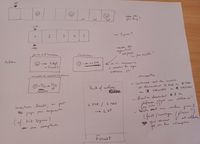
First design notes about Greylune, mostly in French.
My first page of note (shown above) starts with the drawing of two tracks:
- an XP (experience) track, where the would gain new workers every few steps and a few Victory Points on the final steps
- a track for both STR (strength) and MAG (magic), starting at 1 and going up to 5
Further down the page are three actions, each of them using a worker:
- Go on an adventure
- Train
- Boast about one's feats at the tavern
I haven't written down how these actions were supposed to integrate into the game, which probably means that it was really obvious to me at this point – about as obvious as the current date.
The first page also describes the encounters, which have requirements and one among three colors (with the note: forest/mountain/plain) which is used for set collection. No rewards are mentioned, but the "Pack of wolves" card I have sketched nearby shows that there is one.
On the second page, I have noted down that encounter cards are placed in a row at the beginning of each round. A "Travel X" action would allow a player to move their "Adventurer pawn" up to X steps.
Another note points out that experience points and victory points are too similar and that XP should be removed. They did not last long.
The third page deals with new workers and introduces a new type of cards in the village: Companions. They are similar to items but do not take space in the backpack, they come with a new worker, have a special ability and a way to score victory points, and they reduce income by one gold.
Designing With Placeholders
Most of the ideas from these three pages of notes found their way in the final version of Greylune – even if I could obviously not know that at this stage. What mattered then, however, was that I had imagined enough of the game to prepare a very rough prototype of "the new Spyrium" or "Spyrium II", as it would still be named for a long time.
Of course, what made this first step much easier in that case, compared to working on a new game from scratch, is that I did not have to imagine everything – I could just use the corresponding parts of Spyrium, at least as a placeholder.
For instance, Spyrium has a random event each round, which each player can use at most once, as an action which they can take either in the placement or in the activation phase. I do not remember at which stage of the history of Spyrium these events were introduced, but since they are not part of the core system, they were probably not there right from the beginning. Here, my initial notes barely mention them: "events? keep about the same at first".
The events in Greylune ended up working slightly differently from the ones in Spyrium – in particular, the players now have to use one of their workers to benefit from the event, which is a more expensive cost than just using their event disk which serves no other purpose. That change means that the events in Greylune should be relatively stronger than the ones in Spyrium, but also introduced a way to use workers stranded in the market between two removed cards. In Spyrium, you had to remove them for nothing, which was punishing and made the players feel bad – whereas in Greylune, you can use one of the workers you have previously placed in the market to trigger the event. That provides a nice backup plan and opens some opportunities for clever play.
Two other elements which I liked in Spyrium and wanted to keep, as far as possible, in its reimplementation, were the tokens with values 1, 2 or 3 which were used in various ways to introduce variation in the effects or costs of some cards; and the immediate rewards which a player could select when they reach 8 VPs then 20 VPs (either money or an extra worker for the first threshold, then the other one for the second threshold). Neither of these was mentioned in my notes, but even my first list of cards in November that year uses tokens. It must have been obvious to me that they could be used in a similar way.
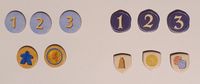
Tokens in Spyrium (left) and Greylune (right).
Successive Versions
My initial goal was to make a set of cards sufficient for the first two rounds of the game – the I decks. I filled a spreadsheet with basic ideas: a few buildings, a few items, a few companions for the Village deck, and then 4 encounters in each of the three terrain types.
The goal was merely to check that the game would still work if I kept working on it in the direction that I had in mind, and that was the case – to some extent. Playing in the village was still similar enough to Spyrium, but the new main part, the encounters, were a bit wonky at first, and the experience could be frustrating. The single row of encounters did not work well and was too frustrating, so that would have to change.
It was still early 2024 and the game was not the current priority for SWAF, but I was in touch with Matthieu regularly and we exchanged ideas. Also, whereas my usual prototypes are minimalist or very rough – much to the despair of playtesters – he provided me with a much better-looking version, including placeholder artwork.
There have been several main versions over the following few months. The encounters were improved by gaining a fixed distance. Since more encounters would be within reach, the players could plan alternative moves more easily – and the distance could be a factor to adjust when making the encounters more varied, but still balanced.
The second version still had only two decks of cards, and we only made the III cards in the third main version, although we had known all along that there would be three periods. What was clear to me as well was that – like in Spyrium – there should be only nine cards in the final period, so that players could know in advance what they could expect, without someone being at the mercy of an unlucky draw if the key card for their strategy would not appear.
Among the changes introduced in this third version, one of them is obvious, at least in retrospect: instead of having three available actions on their personal board, the players would have only one space and would have to decide if they wanted to use it to improve their skills, tell a story, or travel. Fewer villagers used on the personal board means that more of them are used in the village, where they interact with the other players.
The quests were also added in this version, as variable strategic goals to complement the mainly tactical play in the village and with the encounters. Each of them had its own VP value at first and it wasn't until much later that the reward was changed to depend only on the distance – a much easier solution.
How To Tell a Story
The fourth main version was the final one, when we finally changed the way encounters were turned into stories. The different types of encounters, corresponding to symbols which the players were collecting and turning into points, were replaced with a numerical value. I was not really convinced at first by Matthieu's proposal, as I feared that it would be too abstract, but I had to admit pretty quickly that it worked much better than the previous one.
That change also allowed us to provide much more varied tavern rewards, instead of only VP – and distinguish between the most mundane adventures (with value 0) which are not even worth telling, the anecdotes (with value 1) which would get you a small reward at the tavern, up to the epic stories (with value 3) which would attract a large audience and the biggest rewards.
Now we had reached a point where we were satisfied with the core system we had, and the following months saw a succession of minor changes. We playtested, took notes about the cards which the players liked and the ones they tended to ignore, sent each other post-game reports and comments, and discussed regularly to prepare a new version.
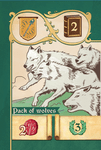
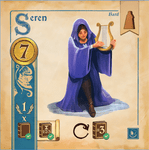
Final versions of an Encounter and a Village card
Meanwhile, Ulric and David started working on the artwork – another major step towards the finished game, and another improvement to the prototypes used for the final playtests, just like the custom wooden villagers.
And once everything was ready, we just had to wait a few long months until the game was produced and finally ready for the players to go on adventures and tell their stories.






 English (US) ·