
.jpg)
PROTECT YOUR DNA WITH QUANTUM TECHNOLOGY
Orgo-Life the new way to the future Advertising by Adpathway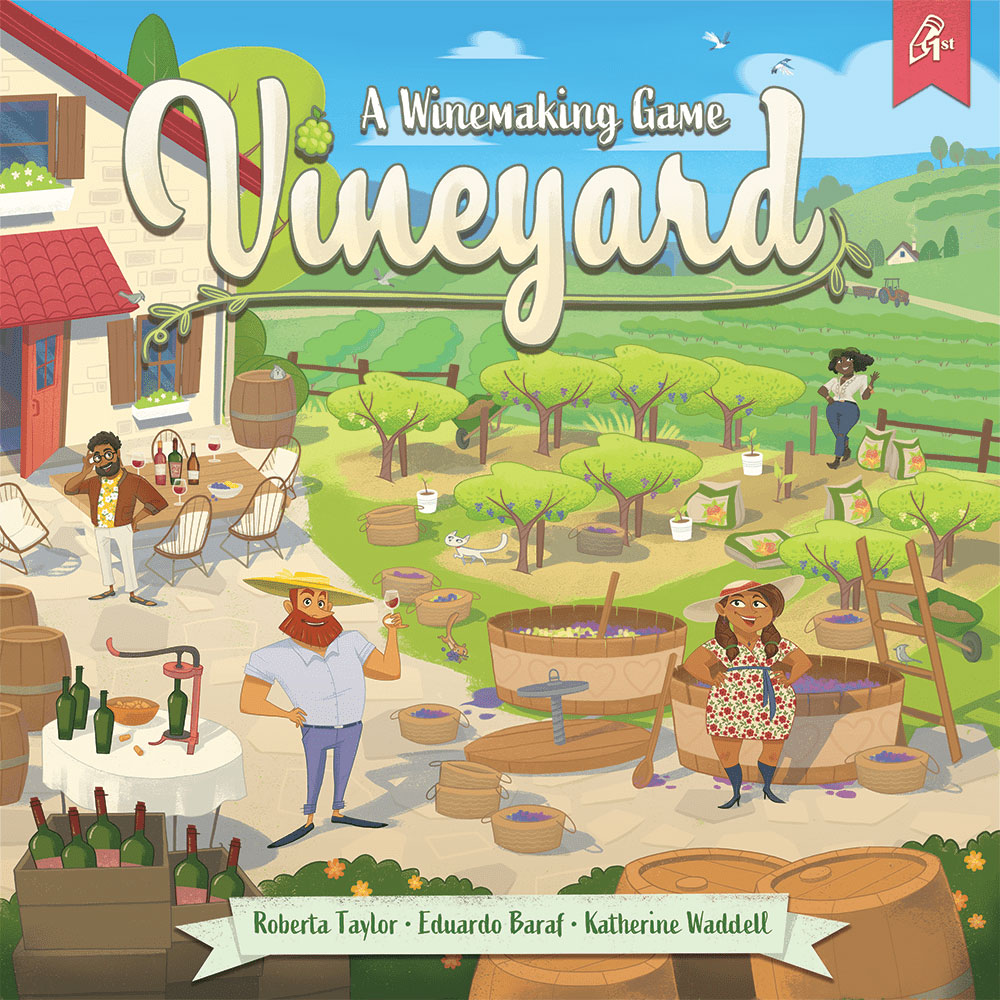 Vineyard has maybe the most bizarre thematic dissonance of any game I’ve played in 2025. On the surface, it’s a game about rival winemakers competing to export the best merlot or whatever. However, further inspection reveals that players actually own the same vineyard, but are still competing to have the best wine. But actually, players don’t own the vineyard at all; it’s owned by four non-player “friends,” and you all share control of these friends to do all the work so that you can win the acclaim… for the wine you all helped make together? And players can upgrade different actions for different friends, so each friend is better at certain tasks but only when being “helped” by certain players…
I don’t normally get stuck on thematic integration in my games, but Vineyard’s mechanisms feel more suited to a hyper-paranoid depiction of the Cold War than to a pleasant game about crushing grapes, which threw me every time I set it up. Definitely not the best first impression, but I’ve turned around on games with equally off-putting theming before—can Vineyard do the same?
Vineyard is a worker-movement game for 1-4 players, and plays in around 60 minutes.
Gameplay Overview:
Vineyard is a game about making wine. On your turn, you play one of the cards from your hand into an available column of your player board (corresponding to one of four friends working in the vineyard), move the relevant friend to the action space listed on the card, and take that space’s action.
 The visitor cards in Vineyard provide money or stars based on different criteria, with the rewards becoming more tantalizing with each tier. While there are a lot of different cards, though, the possibilities are pretty narrow, with each card providing roughly the same value as any other at any given time.
Five of the game’s seven actions directly relate to the winemaking process: harvesting and cultivating grapes, making and aging wine, and loading aged wine barrels onto a truck. Each time you take one of these actions, you place some of your heart tokens on the corresponding output of that action; as wine moves further and further along in the production process, more and more hearts accumulate, finally scoring points for their respective player when wine is finally loaded onto a truck.
The other two actions in the game are more administrative. The Greet action lets you take a visitor card and gain its one-time benefits, and the Paperwork action has you pick up all your previously-played cards for a reward, then spend your entrepreneurial spoils on upgrades. The columns on your player board can be upgraded to make a specific action stronger when you use a specific friend to take that action, and a randomized shop of action cards lets you swap out your initial cards for more powerful ones–taking multiple actions in a turn, gaining extra benefits during your action, and so on.
The game ends once three trucks have been fully loaded with wine, at which point the player with the most points is the winner.
 The hearts on wine barrels denote who contributed the most to the production of that wine. In this case, green contributed alone to one barrel, yellow contributed alone to two, and they collaborated on a single barrel, which will likely be ignored by both parties until the last possible second.
Game Experience:
On paper, Vineyard has some good ideas. Chaining different action cards to different friends to make your actions as efficient as possible is a neat puzzle, and there’s a potentially interesting semi-cooperative undercurrent to spice things up. You can use the work of other players for your own benefit, but that player will also reap some benefits when the resulting wine is finally loaded. The action upgrades also push players into their own play style, leading to more and more asymmetry over the course of the game. Unfortunately, Vineyard is kind of a drag to actually play—none of its elements feel as interesting as I thought they would, and the overall experience is less than the sum of its already underwhelming parts.
 Advanced action cards provide more flexibility and strength to your actions, but until you pick up a few your turns will feel anemic and uneventful. It doesn’t help that every advanced actions is either “do two things” or “do one thing with a bonus”, which makes each purchase less exciting.
The card play, for example, never leads to much interesting decision-making. You’re occasionally stymied by the inopportune placement of a specific friend at a specific action, but you can almost always accomplish what you want with only a minor inconvenience. It lacks the agonizing tension of a good worker placement game, and doesn’t provide the head-scratching pleasure of an in-depth management game.
Your available actions are also bland. Every wine-making action provides you with similar amounts of points in the end, so each one feels indistinguishable from the others. Actions feel more or less the same without any satisfaction of a clever play, rendering the entire procedure a chore rather than a challenge. While in theory, players are helping each other by utilizing their grapes or wines in their actions, in reality, this feels less like cooperation and more like accidental arbitrage. I never helped another player unless I had no other option, and players never felt compelled to take actions that would incentivize me to help them.
 Your vineyard is filled with random grape tokens from a bag, which replenishes as grapes are harvested. The actual process of cultivating and harvesting grapes follows a set of overly-complicated minigames, which unfortunately don’t add nearly as much decision-making as they add rules.
Despite rattling along at a reasonable clip, Vineyard feels much longer than it is due to its lack of texture. Turns never feel particularly good or bad, and the game never changes due to its own enforced three-part structure after each truck is fully loaded, new wine barrels and visitor cards are drawn from a different deck, with more stringent requirements and tantalizing rewards. The game gets harder as players get stronger, but it doesn’t get much more complex, which makes the game feel stagnant.
Final Thoughts:
My thoughts on Vineyard can be fully captured by a resigned shrug and the word “Meh.” Nothing about the game is broken or unbalanced, and it certainly looks nice on the table, but at no point did I ever feel excited, or tense, or even angry. My friends and I simply sat at a table for an hour moving pieces, and by the end, we were already forgetting this game existed.
Final Score: 2.5 Stars – A technically competent game that I do not ever see myself wanting to play.
 Hits:
Hits:
• Good production values
• Some theoretically interesting mechanisms
Misses:
• Actions are repetitive and uninteresting
• Game feels longer than it is
• No sense of tension or challenge
• Lack of replay value


/pic9625780.jpg)








 English (US) ·